Behind the stories
Piecing a family history together
A memory, a photograph, or a name on a document can open a new question. My research brings those pieces together to understand what my grandparents experienced.
Family testimony
Eva’s and Masha’s recorded recollections, and stories passed through the family, give these histories a personal voice. Dates and details in recollections sometimes differ from other records. I try to make clear when a detail comes from someone’s recollection and when it comes from a written record.
Archival records
Prisoner registration and postwar refugee records offer another view. These forms were created for particular purposes and can contain errors, unfamiliar spellings, or information recorded under coercion. A document is evidence to examine, not an infallible biography.
Published histories
Community histories help place an individual life in its wider setting. Translations and later accounts have their own sources and limits. When I cannot resolve a detail, I leave that question open.
Some pages discuss persecution, forced labor, and the loss of family members. The records are shared to help explain these lives.
Family records & further reading
Personal recollection
My own memory of Eva meeting my daughter in October 2007 and the words she said to me.
Arik Cohen, personal recollection of Eva meeting his daughter for the first time in October 2007. Direct memory, not secondhand family oral history or a recorded transcript.
Document
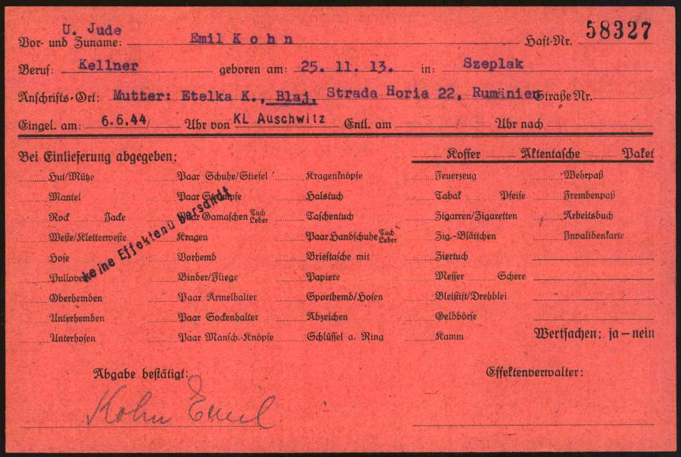
Family-held card recording prisoner number 58327 and admission on June 6, 1944, from Auschwitz.
Emil Kohn, personal-effects card, prisoner number 58327, family-held copy supplied by Arik Cohen. Admission entry reads June 6, 1944, from KL Auschwitz. Exact archival identifier and receiving-camp provenance remain to be matched.
Document
A family-held copy of an archival record, with selected fields explained.
Emil Kohn, prisoner registration form, family-held archival copy. Name and birth-date fields inspected; exact archive collection and document identifier still to be matched.
Document
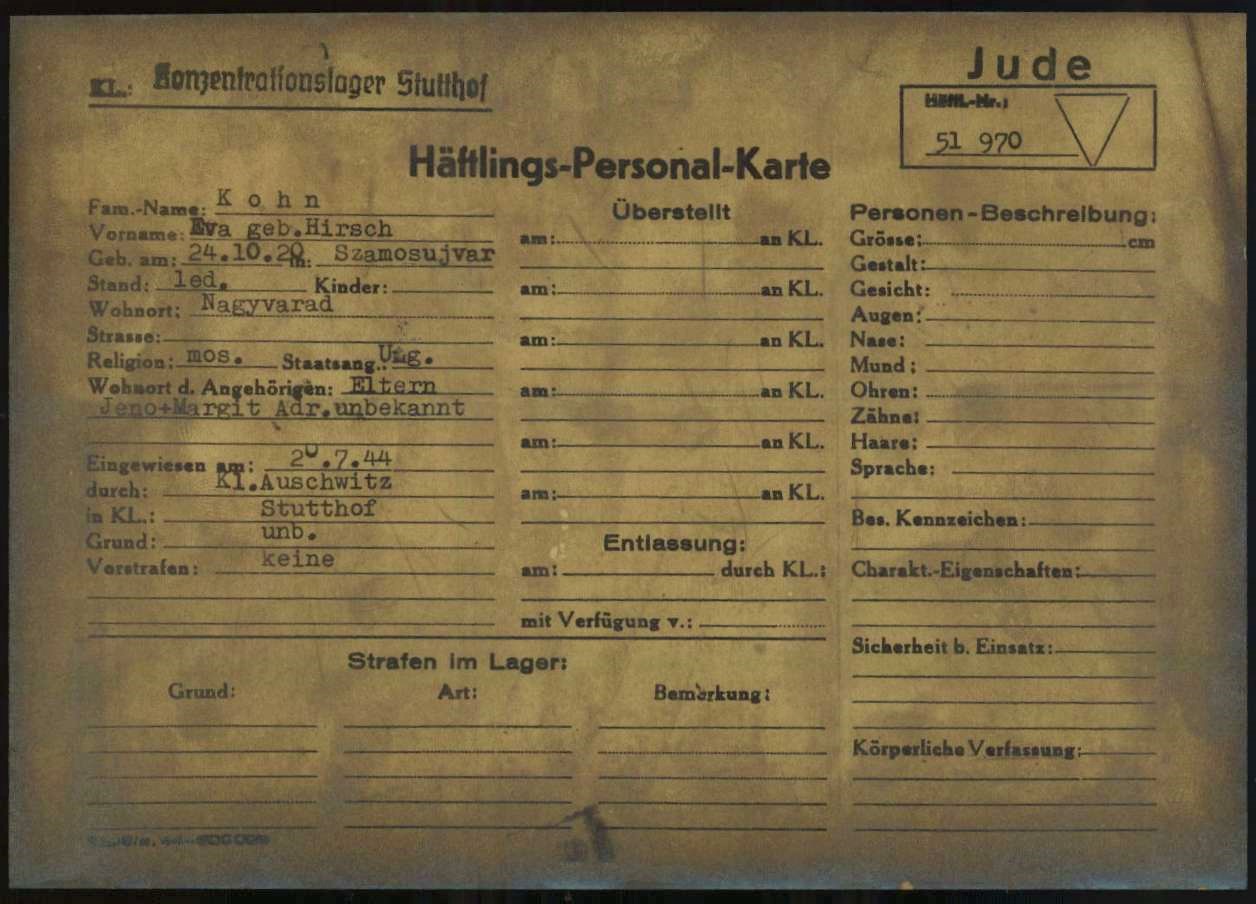
ITS / Arolsen Archives record of admission from Auschwitz on July 20, 1944; prisoner number 51970.
ITS / Arolsen Archives, Eva Kohn née Hirsch, Stutthof prisoner personnel card, number 51970, admission July 20, 1944 from KL Auschwitz. Family-held copy supplied by Arik Cohen; accompanying reference card and archival file cover preserved. Exact online archival identifier pending.
Testimony
Eva’s own recorded testimony. Collection credit and remaining catalogue and translation details are explained in the source note.
Eva Kohn, testimony recorded May 22, 1995; Survivors of the Shoah Visual History Foundation. I have confirmed the recording date; I am still looking for the interview number and exact segment references.
Family oral history
An account of how these family stories were passed down, with the limits of an unrecorded oral tradition made explicit.
Stories my grandparents told my parents, who later passed them on to me. These accounts were not written down.
Museum history
Identifies the villa as the Frenkel family home beside their leather factory. This source identifies the building; my account of Aryeh’s employment there comes from our family history.
Šiauliai Aušros Museum, “Chaimas Frenkelis Villa-Museum,” official museum description.
Personal recollection
Kalman’s recollection describes escaping with Aryeh, searching for shelter and returning to seek news of Masha. Our family’s account is that she joined them at that point. Download the original Word document.
The Story of my Grandfather, Callman Lurie as told by him. Kalman told his story to his grandson Gal, as identified by Arik Cohen. Family-held English document supplied by Arik; date, translator and exact preparation of the written account unspecified.
Historical context
Historical context for forced labor at the oil works. This account does not establish Emil’s assignment there.
Gedenkstätte Buchenwald, Lützkendorf, Netzwerk der Außenlager. Describes Buchenwald prisoners assigned to construction, dismantling and clearance at the oil works from July 1944. Context only; Emil’s assignment is unconfirmed.
Photograph
Official aerial photograph of the damaged plant. Historical context, not evidence of Emil’s personal assignment.
National Archives, NAID 204905987, local identifier 342-FH-3A21908-A81114AC, aerial view of the bomb-damaged synthetic oil plant at Lutzkendorf, Germany, May 12, 1945. Record Group 342; photograph scan, image 1 of 2.
Testimony
My grandmother Masha’s interview with Gal Rosen, including the account I know of her journey through Aliyah Dalet. I do not yet know the recording date.
Masha Schneider, family interview recorded by Gal Rosen, date unknown. We hold the recording in our family collection. This is the interview I know as the source of her Aliyah Dalet account; the passage and timecode still need to be checked.
Document
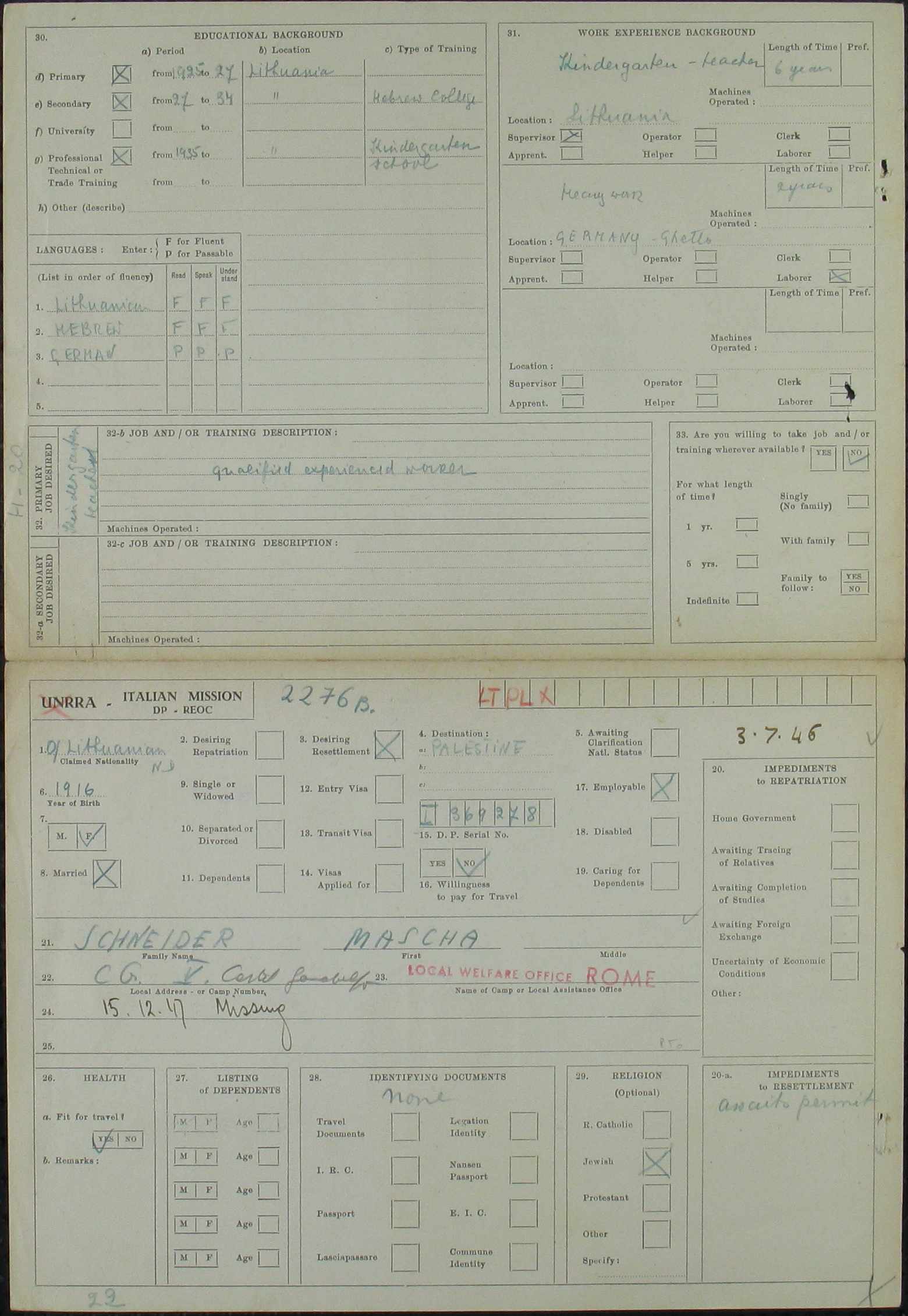
Masha’s card records her kindergarten teaching background and her desired destination of Palestine. Open the complete original image.
UNRRA Italian Mission, displaced-person card for Schneider, Mascha. Arolsen Archives copy preserved in Arik Cohen’s family collection as Masha-RefugeeCard.jpg.
Document
A family-held copy of a postwar record showing how displacement continued after liberation.
UNRRA Italian Mission, displaced-person card for Schneider, Leib. Arolsen Archives copy from Arik Cohen’s family research collection; identified by Arik as his grandfather Aryeh’s card.
Historical source
Published prisoner lists. I identify Kleinaitė Maša on page 444, entry 209, as Masha; her supplied scan records fur processing at a leather factory and flags an uncertain birth date. The entry’s birth details differ from family information. The book also contains Šneideris Leiba on page 471, entry 695.
Irena Guzenberg and Jevgenija Sedova, compilers, The Šiauliai Ghetto: Lists of Prisoners, 1942 (Vilnius, 2002), p. 444, entry 209; p. 471, entry 695.
Historical source
Historical context for the ghetto and the November 5, 1943 roundup. This is not evidence of an individual family member’s escape or hiding place.
Yad Vashem, Testaments of Jews from Shavli, introductory historical account, pp. 1–2.
Published history
A translated account in JewishGen’s Yizkor Book Project includes Arye Schneider’s recollections. Look for the Šaukėnai (Shukian) section.
“Šaukėnai (Shukian),” in The Holocaust in 21 Lithuanian Towns, compiled and translated by Joe Woolf, JewishGen Yizkor Book Project. Section includes Arye Schneider’s account and its underlying bibliography. The section’s witness list names Arye Schneider, Nahariya.
Published history
A secondary account of eight young Jews who converted and were later murdered, and a reported memorial tablet. Installation and chronology require further confirmation.
Bill Farran, “Šaukėnai, Lithuania,” Lost Treasures: The Wooden Synagogues of Eastern Europe. Historical note and reproduced memorial inscription; publication date unspecified.
Published history
A history of the town’s Jewish community before the war and during occupation, with references to the underlying archival and published sources.
“Shukyan,” Preserving Our Litvak Heritage, Volume II, pp. 178–185, JewishGen Yizkor Book Project. See the section “During World War II and After.”
Historical source
The November 5, 1943 roundup, Salomea’s recollection of returning from work, and Binyamin’s survival in hiding. Historical context for Masha’s story; not testimony about Masha.
Yad Vashem, “Three-year-old Binyamin Abramovich Survived the Holocaust in Šiauliai, Lithuania, under an Assumed Identity,” Remember Your New Name exhibition, including Salomea Abramovich’s testimony.
Published history
Confirms the May 26–27, 1942 census date. This passage does not independently establish the reported total of 4,665.
Arūnas Bubnys, The Šiauliai Ghetto (Vilnius: Genocide and Resistance Research Centre of Lithuania, 2014), translated by Rokas Tracevskis, p. 11. ISBN 978-609-8037-43-2.
Testimony
Survivor testimony identifying November 5, 1943 and describing the roundup, deportation and subsequent murder of victims at Auschwitz. Historical context for Aryeh’s and Masha’s stories, not testimony about either of them.
Nesse Galperin Godin, “Nesse Galperin Godin describes a roundup in the Siauliai ghetto,” oral-history excerpt and transcript, US Holocaust Memorial Museum, Holocaust Encyclopedia.
Published history
Published history supporting the Yiddish name Shavli and general ghetto conditions. It does not describe Aryeh or Masha’s personal daily routine.
Josef Rosin, “Siauliai,” Pinkas Hakehillot Lita (Yad Vashem, Jerusalem, 1996), pp. 658–672, translated by Shimon Joffe. English translation hosted by JewishGen; ghetto housing, work and restrictions passages reviewed October 3, 2026.
Published records
The supplied page records Šneideris Leiba, born 1910 in Šaukėnai, occupation carpenter/joiner. I identify him as my grandfather Aryeh. The page has no address heading and leaves the workplace identification unresolved.
The Šiauliai Ghetto: Lists of Prisoners, 1942, compiled by Irina Guzenberg and Jevgenija Sedova, Vilna Gaon Jewish State Museum. Book identified by Arik Cohen; supplied scan, printed p. 471, entry 695 (Šneideris Leiba), visually reviewed October 3, 2026. Catalogue record NNL_ALEPH990023749870205171.
Historical context
USHMM history of the camp system and its evacuation. The figures cover Stutthof and its subcamps, not Eva’s individual column.
United States Holocaust Memorial Museum, Holocaust Encyclopedia, Stutthof, Death Marches and Evacuations. Nearly 50,000 prisoners in the camp system at the final evacuation; estimated over 25,000 deaths across the evacuation.
Published history
A local heritage account of the ghetto and the October 1941 massacre. Indexed text consulted October 3, 2026; the direct page returned a server error.
Jewish Heritage Lithuania, “The site of the massacre of Jews in Žagarė (Šiauliai County).”
Published history
A brief history describing forced labor and restrictions, with a historic town photograph. The photographer and photograph date are not identified in the English article.
Evaldas Balčiūnas, “Mysteries of the Žagarė Ghetto,” Lithuanian Jewish Community, November 5, 2018; credited to bernardinai.lt.
Published history
The town history records deprivation in the ghetto and the coercion of Rabbi Yisrael Reif and his congregants. This is historical context, not Aryeh’s testimony.
Dov Levin, “Žagarė,” Pinkas Hakehillot Lita, pp. 277–282 (Yad Vashem, Jerusalem, 1996), translated by Melanie Rosenberg, JewishGen Yizkor Book Project. See “World War Two and its Aftermath.”
Published history
Historical context for confinement, forced labor and the October 2, 1941 massacre. This town history does not establish individual family members’ fates.
Yad Vashem, Encyclopedia of the Ghettos, “Žagarė,” Hebrew entry, record 354.
Research still in progress
I am still tracking down precise references for some family details, including the interview identifier and passages for Eva’s May 22, 1995 testimony, the passages of Masha’s interview recorded by Gal Rosen (date unknown), and who first told particular parts of Emil’s journey home. I have marked those gaps on the story pages.
You can watch my talk on the Watch & learn page. To explore the evidence behind it, follow the references here to the original testimony, documents and published histories.